Weather Alert in Minnesota
Winter Weather Advisory issued March 31 at 11:13PM CDT until April 2 at 7:00PM CDT by NWS Aberdeen SD
AREAS AFFECTED: Traverse; Big Stone; Brown; Marshall; Roberts; Day
DESCRIPTION: * WHAT...Mixed precipitation and patchy blowing snow expected. Total snow accumulations between 3 and 5 inches and ice accumulations around a light glaze. * WHERE...Portions of west central Minnesota and northeast South Dakota. * WHEN...From 7 AM Wednesday to 7 PM CDT Thursday. * IMPACTS...Travel could be very difficult. Mainly drifting snow is expected, but in areas prone to blowing snow, the snow may be lofted and briefly reduce visibility. the combination of warm temperatures and drifting snow can cause snow to adhere to roads, creating icy patches. The hazardous conditions could impact the Wednesday morning and evening commutes.
INSTRUCTION: Slow down and use caution while traveling. In Minnesota, the latest road conditions can be obtained at 511mn.org, or by calling 5 1 1. In South Dakota, the latest road conditions can be obtained by calling 5 1 1.
Want more detail? Get the Complete 7 Day and Night Detailed Forecast!
Current U.S. National Radar--Current
The Current National Weather Radar is shown below with a UTC Time (subtract 5 hours from UTC to get Eastern Time).

National Weather Forecast--Current
The Current National Weather Forecast and National Weather Map are shown below.

National Weather Forecast for Tomorrow
Tomorrow National Weather Forecast and Tomorrow National Weather Map are show below.

North America Water Vapor (Moisture)
This map shows recent moisture content over North America. Bright and colored areas show high moisture (ie, clouds); brown indicates very little moisture present; black indicates no moisture.

Weather Topic: What are Altocumulus Clouds?
Home - Education - Cloud Types - Altocumulus Clouds
 Next Topic: Altostratus Clouds
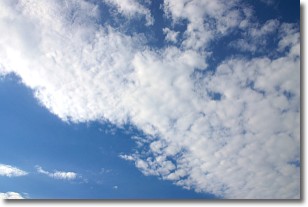
Similar to cirrocumulus clouds, altocumulus clouds are
characterized by cloud patches. They are distinguished by larger cloudlets
than cirrocumulus clouds but are still smaller than stratocumulus clouds.
Altocumulus clouds most commonly form in middle altitudes (between 2 and 5 km)
and may resemble, at times, the shape of a flying saucer.
These uncommon formations, called altocumulus lenticularis, are created by uplift
in the atmosphere and are most often seen in close proximity to mountains.
Next Topic: Altostratus Clouds
Weather Topic: What are Cirrocumulus Clouds?
Home - Education - Cloud Types - Cirrocumulus Clouds
 Next Topic: Cirrostratus Clouds
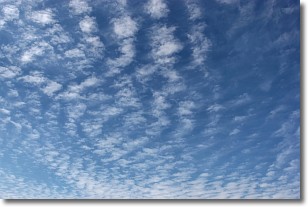
Cirrocumulus clouds form at high altitudes (usually around 5 km)
and have distinguishing characteristics displayed in a fine layer of
small cloud patches. These small cloud patches are sometimes referred to as
"cloudlets" in relation to the whole cloud formation.
Cirrocumulus clouds are formed from ice crystals and water droplets. Often, the
water droplets in the cloud freeze into ice crystals and the cloud becomes a
cirrostratus cloud. Because of this common occurrence, cirrocumulus cloud
formations generally pass rapidly.
Next Topic: Cirrostratus Clouds
Current conditions powered by WeatherAPI.com